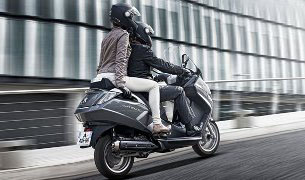
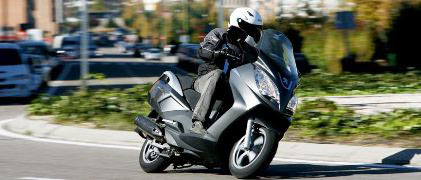
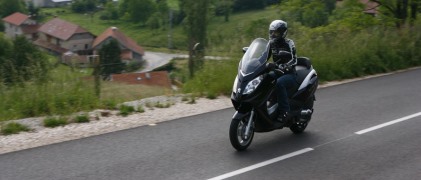
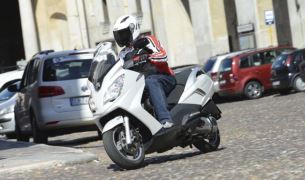
Even after Vespa had abandoned the shores of the New World for many years, driver’s test examiners would beckon to any scooter rider on a Cushman, Honda or Yamaha, “Hey, you on the Vespa, it’s your turn.” These easy-handling scooters were the best way to literally breeze through your motorcycle test with flying colors.
Vespa had any number of reasons to leave the U.S. market long ago, and had equally good reasons to return here just a few years ago. The Vespa panache stayed in the consciousness of Americans for all these years, and our memories grew fonder. When the company finally returned, it had far more to offer than smoky 49cc runabouts.
The modern age of Vespa features strong, clean-burning four-stroke engines. The largest and newest offering, the Vespa GTS, features the versatile 244cc Quasar (QUArter liter Smooth Augmented Range) power plant found in several Piaggio and Aprilia scooters. Beyond the engine, Vespa style and ease of handling shines through in every respect. In fact, the physical dimensions of the GTS are the same as the 198cc Granturismo model (which is a bit too small to qualify among our ScooterMaxi models). These “big” Vespas are hardly larger physically than the smallest scoots. With its light weight and small overall size, the scooter is quick, nimble and supremely confidence-inspiring. Ideal for any urban terrain, the GTS puts any Prius to shame by sipping fuel sparingly. No wonder reviewers have heaped much praise on the new model.
Vespa never intended the GTS or any of its other offerings as long-distance tourers or freeway cruisers. At 2.4 gallons of gas tank capacity, you probably won’t be crossing Montana on this scooter. The GTS can easily handle Interstates for short jaunts, but it just doesn’t look right there. At those higher speeds, the Vespa is bound to feel a bit busy. In fact, it does better than expected as it nears max speed, taking into consideration the limitations of an extremely short wheelbase and 12” wheels. Carrying a very light vehicle weight load and a low center of gravity works well in its favor for most situations, even on twisty country roads.
In the specifications, you might notice that the seat height looks a bit daunting for smaller inseams. Frankly, figures don’t tell the whole story. The seat is relatively narrow, and favorable scooter dynamics converge to make the height adequately low for most riders.
We feel that the Vespa GTS is a pretty good value. Although not quite as technologically sophisticated as the Piaggio MP3 (which shares the same engine), it is priced much lower. Even if you anticipate outgrowing the GTS down the line, you can be reasonably confident that your Vespa will keep most of its value when the time comes to sell.
A limited number of the GTS 250 Super were imported into the U.S. in late 2008 followed by the torquier GTS 300 Super (278cc) coming into the market in 2009. Although not huge factors, you will want to consider the subtle styling, performance and functional differences among these three models.
What really counts for any Vespa are style, sophistication and a nimble, fun ride around town. Going “big” compared to earlier models hasn’t at all compromised the enjoyment and fascination that has kept the Vespa name so intriguing to us for all these years.